The Evolution of Training: How Artificial Intelligence and Machine Learning Are Transforming Driver Preparation and Car Setup
Over the past decade, motorsport has undergone a fundamental shift in how drivers train and how race cars are prepared. Artificial intelligence and machine learning are no longer experimental tools reserved for data scientists; they have become core components of modern racing operations. By 2025, these technologies influence everything from physical conditioning and cognitive training to aerodynamic setup and race strategy, changing the relationship between driver, engineer, and machine.
Artificial intelligence in modern driver training programmes
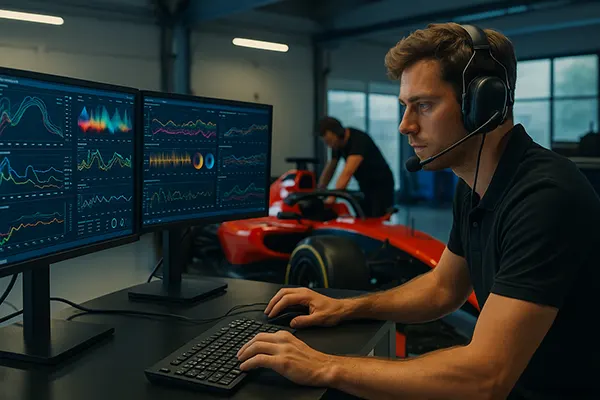
Driver preparation has traditionally relied on experience, coaching intuition, and repetition. Today, AI-driven systems analyse thousands of data points collected from simulators, biometric sensors, and on-track telemetry. This allows teams to build detailed performance profiles that reflect not only lap times, but also reaction speed, braking consistency, steering input smoothness, and fatigue patterns.
Machine learning models are now used to personalise training regimes for individual drivers. By comparing historical data across multiple seasons and categories, these systems can identify subtle weaknesses that may not be visible to human coaches. For example, AI can detect delayed throttle application under high tyre degradation or reduced concentration during long stints, allowing targeted corrective exercises.
In elite categories such as Formula 1 and endurance racing, AI-assisted training has also improved injury prevention. Continuous monitoring of muscle load, neck strain, and cardiovascular stress enables teams to adjust workloads before overuse injuries occur, extending driver longevity and maintaining peak performance throughout a demanding calendar.
Simulation, cognitive load, and decision-making analysis
Advanced simulators powered by machine learning now replicate real-world racing conditions with remarkable accuracy. AI adapts track evolution, weather changes, and competitor behaviour in real time, forcing drivers to make decisions under pressure that closely resemble actual race scenarios.
Cognitive load analysis has become a key focus area. AI evaluates eye movement, reaction latency, and information processing speed during simulated races. This data helps coaches understand how drivers manage stress and multitasking when dealing with tyre management, radio communication, and tactical decisions simultaneously.
By 2025, several teams integrate neurofeedback into simulator sessions. Machine learning algorithms adjust difficulty levels dynamically, ensuring drivers remain in an optimal learning zone where concentration is challenged but not overwhelmed. This approach accelerates skill acquisition while reducing mental fatigue.
Machine learning and data-driven car setup optimisation
Car setup has evolved from a process dominated by engineering intuition into a data-intensive discipline guided by machine learning. Modern race cars generate vast quantities of telemetry covering suspension movement, tyre temperatures, aerodynamic load, and energy deployment. AI systems process this information far faster than traditional analysis methods.
Machine learning models can predict how setup changes will affect performance under specific conditions. Instead of testing dozens of mechanical and aerodynamic configurations, engineers now rely on algorithms trained on historical race data, wind tunnel results, and simulation outputs to narrow down optimal solutions before the car even leaves the garage.
This approach has significantly reduced setup time during race weekends. Teams arrive with a more accurate baseline configuration, allowing drivers to focus on fine-tuning rather than fundamental balance issues. The result is more consistent performance across varying circuits and weather conditions.
Tyre behaviour, aerodynamics, and real-time adjustments
Tyre management remains one of the most complex challenges in motorsport. Machine learning models analyse temperature distribution, wear rates, and grip degradation to forecast tyre behaviour over long stints. This enables engineers to select setups that maximise performance without compromising durability.
Aerodynamic optimisation has also benefited from AI integration. By correlating CFD data with on-track measurements, machine learning systems identify discrepancies between theoretical and real-world performance. Engineers can then adjust ride height, wing angles, and cooling configurations with greater confidence.
In 2025, real-time data processing allows limited in-session setup adjustments within regulatory constraints. AI assists engineers in making rapid decisions during practice sessions, improving efficiency while remaining compliant with sporting regulations.
Strategic integration of AI across the racing ecosystem
The influence of artificial intelligence extends beyond individual drivers and cars. Teams increasingly use machine learning to coordinate training, engineering, and race strategy into a unified system. This holistic approach ensures that human decision-making is supported by objective data rather than replaced by it.
Race strategy tools powered by AI evaluate millions of potential scenarios involving safety cars, weather shifts, and competitor behaviour. While final decisions remain with strategists, machine learning provides probabilistic outcomes that improve risk assessment and timing accuracy.
Importantly, teams recognise that AI is most effective when combined with human expertise. Engineers and drivers interpret algorithmic recommendations through the lens of experience, ensuring that technology enhances, rather than dictates, competitive judgement.
Ethical limits, regulations, and the human factor
As AI adoption grows, governing bodies closely monitor its application to maintain sporting integrity. Regulations restrict automated decision-making during races, ensuring that drivers remain central to performance outcomes rather than passive operators of technology.
Ethical considerations also shape development. Teams are cautious about over-reliance on predictive systems that may reduce adaptability or creativity. Maintaining a balance between data-driven precision and human instinct remains a priority.
By 2025, artificial intelligence and machine learning are firmly established as tools that refine, not replace, the skills of drivers and engineers. The future of motorsport training lies in this collaboration, where technology amplifies human potential while preserving the essence of competition.