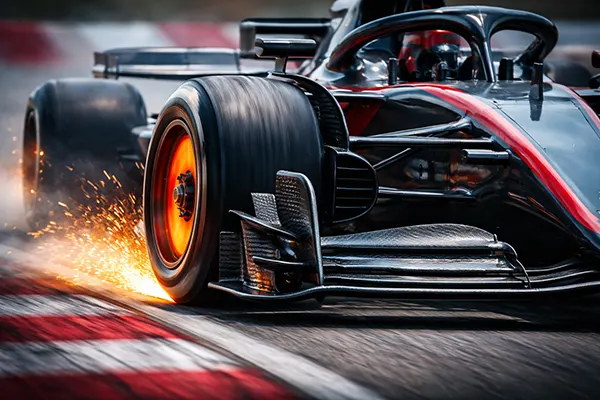
F1: Why Brake Overheating Kills Pace — A Simple Viewer’s Guide
When an F1 car suddenly looks “lazy” on corner entry, it’s easy to blame the tyres or fuel. But very often the real trigger is the brakes. Overheated brakes don’t just risk a lock-up or a wide moment; they change how the driver can attack every braking zone, and that quietly costs lap time. The key is to understand one thing: braking isn’t just slowing the car down — it’s turning speed into heat, and the car has to survive that heat every lap.
The basic physics: where the heat comes from
Braking is energy conversion. A car arriving at a corner carries a huge amount of kinetic energy, and the brake system’s job is to convert that energy into heat through friction. The faster the car, the heavier it is, and the later it brakes, the more energy has to go somewhere. In F1, that “somewhere” is mainly the carbon discs and pads, and the temperatures can sit in the hundreds of degrees and spike much higher under heavy use.
Heat itself is not the enemy; unmanaged heat is. Carbon brakes are designed to operate at extreme temperatures, but the rate of heat input can exceed the rate at which the system can shed it. That happens on tracks with repeated heavy braking, during close racing in dirty air, or when a driver is forced to brake slightly differently because the car isn’t stable. Once the system is beyond its happy range, the driver loses consistency and confidence.
Cooling is a balancing act. Teams channel air to the brakes using ducts, internal passages, and airflow management around the wheel. But you can’t simply open the biggest cooling route every weekend: more cooling hardware and airflow generally means more aerodynamic compromise, different tyre heating behaviour, and sometimes worse top speed. So teams pick a cooling configuration that matches the circuit, weather, and race expectations — and if conditions shift, overheating can arrive quickly.
Why carbon brakes have a “working window”
Carbon-carbon brakes behave differently from road car brakes. They tend to deliver weaker bite when they’re too cool, then build performance as they reach their working range. That means drivers manage not only how hard they brake, but how they warm the brakes, how they keep them stable, and how they avoid sudden temperature swings that change pedal feel.
Once the brakes get too hot, the friction characteristics can become less predictable, the surface can oxidise, and wear can accelerate. The driver may still have enough braking power, but it arrives less cleanly and less repeatably. That’s how you get the “long pedal” feeling, a surprise lock-up, or a driver braking earlier than usual just to stay safe.
This is why teams obsess over temperatures rather than just “cool” or “hot”. They want a stable band: hot enough for strong, consistent bite, but not so hot that the discs and pads degrade or the brake-by-wire control has to fight instability. In modern F1, keeping that band stable can be the difference between attacking every lap and protecting the car.
How overheating turns into lost lap time
The first time penalty is simple: earlier braking. If the driver can’t trust the brakes at peak performance, they brake five to ten metres earlier. That might not sound like much, but across multiple heavy braking zones it adds up to tenths, and over a stint it can become seconds.
The second penalty is a weaker corner entry. F1 lap time is built on carrying speed into the corner and rotating the car early so it can launch out. Overheated brakes reduce the driver’s willingness to trail-brake and fine-tune the car’s attitude on entry. Instead of a sharp, committed entry, you get a softer, more conservative one — and that also hurts exit speed.
The third penalty is error risk. When braking performance is inconsistent, the driver starts leaving margin for the worst moment, not the best moment. They avoid the kerb that unsettles the car, they avoid the late-braking duel, and they avoid the aggressive line that demands perfect pedal feel. The stopwatch punishes that caution immediately.
The chain reaction: tyres, balance and aero
Brake overheating rarely stays isolated to the brakes. Heat travels: into the wheel assembly, into the rim, and into the tyre. That can push tyre temperatures beyond their ideal range, especially on the front axle where lock-ups and slides are most costly. An overheated front tyre loses grip, and suddenly the driver needs even more braking distance — a vicious circle.
Balance also shifts. If the rear system is being controlled through brake-by-wire and energy recovery, the car’s braking balance can feel different from lap to lap depending on battery state, regeneration strategy, and temperature. When the rear contribution changes, the driver adapts by altering pedal application and steering input, and that can create extra scrub and extra heat. The car becomes harder to place precisely.
Aerodynamics plays a role too, especially when following another car. Less clean airflow can reduce cooling effectiveness, and it can also reduce downforce, meaning the car cannot brake as late because the tyres have less vertical load. The driver might compensate by braking a touch earlier and longer, which keeps the brake system under stress for more time. Again, the chain reaction ends with lost pace.
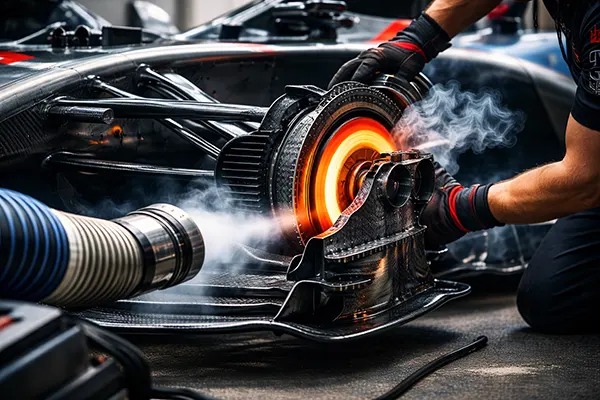
How teams and drivers manage brake heat in modern F1
Engineers start with hardware choices: brake duct sizing, internal airflow paths, and how heat is guided away from sensitive components. They also manage how heat is retained or shed depending on the circuit’s demands. A stop-start track needs aggressive cooling; a track with fewer big stops might need heat retention to keep bite consistent. The setup is never “one size fits all”.
Drivers manage temperatures with technique. They may adjust braking pressure ramp-up, avoid dragging the brakes unnecessarily, and change how they attack kerbs that unsettle the car under braking. In some situations, they will deliberately create a short cooling phase by lifting earlier on a straight or by changing the line slightly to reduce peak demand. That is lap-time sacrifice in the short term to regain stability in the long term.
In the 2026 era, the interaction between friction braking and energy recovery becomes even more important. With stronger regeneration capability and evolving braking system demands, the rear braking behaviour and thermal management can become more sensitive to strategy choices. That makes brake management not only a hardware and driving issue, but also an energy deployment and control problem across a stint.
What to watch on TV: clues that the brakes are too hot
Look for changing braking points. If a driver who was consistently outbraking a rival suddenly starts braking earlier, lap after lap, that’s often a sign of reduced confidence in the brake phase. Commentators may call it “managing” or “looking after the tyres”, but the brakes can be the hidden reason the tyre phase is deteriorating in the first place.
Watch for lock-ups that come in clusters. One lock-up can be a mistake. Several lock-ups across consecutive laps often point to an underlying consistency issue — either the brakes are not in their ideal temperature band, or the balance is shifting with energy recovery and temperature. A driver will then back off to avoid flat spots and further damage.
Listen for radio cues and observe onboards. Drivers might mention “long pedal”, “no bite”, or “rear instability” under braking. You may also see them avoid aggressive trail-braking and rotate the car later. The car looks calmer, but it’s slower: a cautious entry usually means a compromised exit, and that’s where the lap time disappears.