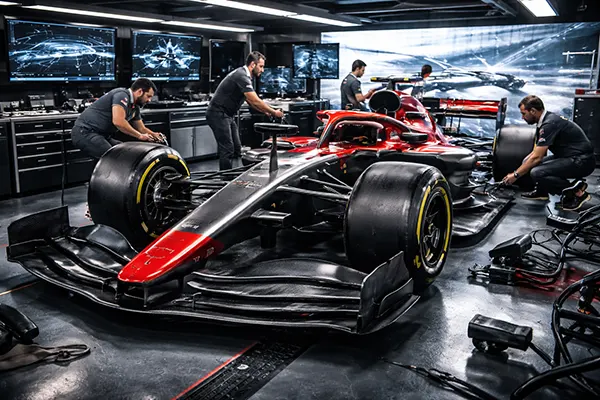
Car Development Through the Season: How Teams Decide What to Bring to a Grand Prix
In modern Formula 1 and other top-tier single-seater championships, a racing car is never a finished product. From the opening round in March to the final event in late autumn, every chassis evolves. Aerodynamic packages, floor revisions, suspension tweaks and software updates appear regularly, sometimes in small increments, sometimes as major step changes. Behind each new component lies a complex decision-making process shaped by data, budget constraints, simulation tools and the specific demands of upcoming circuits. Understanding how teams choose what to introduce at each Grand Prix offers a revealing look into the competitive and technical reality of the 2026 season.
Balancing Performance Gains and Development Costs
Under the current cost cap regulations, which remain a central pillar of Formula 1 governance in 2026, every upgrade must justify its expense. Teams operate within a strict financial limit covering car development, production and operations. This forces technical directors to weigh the projected lap-time gain of a new part against the manufacturing cost, wind tunnel hours and CFD allocation required to produce it.
Performance targets are quantified with precision. Engineers estimate gains in milliseconds per lap based on simulation data, correlating CFD, wind tunnel results and track telemetry. If an upgraded floor is expected to deliver two tenths of a second on average circuits, it may receive priority over a more marginal front wing tweak offering only a few hundredths.
Opportunity cost also plays a decisive role. Allocating resources to a mid-season update may delay development of a larger concept shift planned for later races. In 2026, with stable aerodynamic regulations but continuous refinement of ground-effect understanding, teams frequently choose between incremental improvements and a more ambitious aerodynamic package timed for a European or flyaway triple-header.
Correlation Between Simulation and Track Data
No upgrade decision is taken purely on theoretical promise. Correlation remains the cornerstone of development strategy. Teams compare wind tunnel outputs and CFD simulations with real-world telemetry from previous Grands Prix to ensure that their models reflect on-track reality.
If a team identifies a mismatch between predicted and actual downforce levels, it may pause new aerodynamic introductions to address correlation issues first. Bringing unverified parts to a race weekend risks wasting both financial resources and valuable track time, particularly under restricted practice formats.
By 2026, simulation sophistication has increased significantly, yet the margin for error remains narrow. Accurate correlation allows teams to introduce updates with confidence, often arriving at a circuit knowing within a few points of aerodynamic load what the new package should deliver.
Track Characteristics and Calendar Strategy
Not all circuits reward the same type of upgrade. High-speed venues such as Monza demand low-drag efficiency, while tracks like Monaco or Singapore prioritise mechanical grip and maximum downforce. Teams therefore align development cycles with the calendar, targeting specific Grands Prix for particular packages.
A major aerodynamic overhaul is often introduced at circuits that provide a representative mix of corners, enabling clearer performance evaluation. Barcelona and Silverstone have historically served as benchmarks due to their varied layouts. In 2026, these venues remain key reference points for validating comprehensive upgrade packages.
Logistics further influence timing. With a global calendar spanning multiple continents, freight deadlines are strict. Components must be finalised weeks before overseas races. As a result, some updates are strategically delayed for European rounds, where factory proximity allows faster production and iterative refinement.
Adapting to Sprint Weekends and Limited Practice
The continued presence of Sprint formats in 2026 complicates development scheduling. With only a single practice session before parc fermé conditions apply, teams are cautious about debuting complex packages during Sprint events.
Limited practice reduces the opportunity to gather comparative data between old and new specifications. For this reason, substantial aerodynamic updates are typically reserved for standard race weekends, where teams have more freedom to adjust set-ups and conduct back-to-back testing.
However, minor updates—such as revised cooling inlets or brake duct modifications—may still appear during Sprint rounds if they carry low risk. The balance between ambition and caution becomes particularly delicate in championship fights.

Championship Context and Competitive Position
A team’s position in the Constructors’ and Drivers’ standings heavily shapes development decisions. Title contenders in 2026 often continue aggressive in-season development deep into the calendar, seeking incremental advantages that could decide a close points battle.
Conversely, midfield or lower-ranked teams may pivot resources towards the following year’s car once realistic championship objectives fade. With regulatory stability but continuous refinement of performance concepts, early focus on the next chassis can yield significant long-term gains.
Risk tolerance also shifts depending on context. A leading team may avoid radical design experiments mid-season to preserve reliability, whereas a team outside the points may gamble on bold aerodynamic solutions in pursuit of breakthrough performance.
Reliability, Driver Feedback and Strategic Trade-offs
Performance is meaningless without reliability. Each new component must meet durability thresholds, particularly given the limited allocation of power unit elements and gearbox components across a season. An upgrade that marginally improves downforce but increases thermal stress may be postponed until cooling solutions are validated.
Driver input remains a critical qualitative factor. Modern telemetry is exhaustive, yet feedback regarding balance, stability under braking and tyre behaviour influences which development paths receive priority. If drivers report persistent mid-corner instability, aerodynamic resources may shift towards floor edge control rather than outright peak load.
Ultimately, upgrade decisions represent strategic trade-offs between immediate lap-time gains, long-term development direction and operational risk. In the data-driven, financially regulated environment of 2026, success depends not merely on building faster parts, but on introducing the right ones at precisely the right moment in the season.