Why Battery Cooling Has Become a Critical Factor in Modern Formula E
Battery technology sits at the core of Formula E, shaping performance, race strategy, and safety standards. As power outputs increase and energy deployment becomes more aggressive, thermal management has moved from a background function to a decisive engineering priority. By 2026, battery cooling is no longer just about preventing overheating—it directly affects lap times, consistency, and the ability to compete at the highest level.
The link between battery temperature and performance output
Electric race cars operate within a very narrow temperature window where battery efficiency reaches its maximum. When temperatures rise beyond this range, internal resistance increases, reducing the ability to deliver power efficiently. On the other hand, batteries that are too cold cannot release energy at the required rate, which leads to slower acceleration and weaker response from the powertrain.
In Formula E, where races are tightly contested and margins are minimal, even small deviations in battery temperature can translate into measurable performance losses. Rapid acceleration, heavy regenerative braking, and constant energy cycling generate significant heat within the battery pack. Without effective cooling, this heat builds up quickly, reducing output and forcing the system into protective limitations.
Modern teams rely on highly responsive thermal systems that adapt in real time. Sensors monitor temperature across individual cells, while control systems adjust cooling intensity depending on driving conditions. This ensures that the battery remains within its optimal range, allowing drivers to access full performance when needed.
How overheating directly affects race strategy
When battery temperatures rise too high, teams must immediately adapt their race strategy. Power delivery may need to be reduced to avoid damage, which limits acceleration and top speed at crucial moments. This can affect overtaking opportunities and defensive driving, especially in the closing stages of a race.
Thermal limits also influence how aggressively a driver can use available energy. In situations where the battery is close to overheating, teams may instruct drivers to lift off earlier, reduce attack modes, or avoid pushing during certain sections of the circuit. These compromises can alter race outcomes even if the car is otherwise competitive.
Teams with efficient cooling systems gain a clear advantage. They can maintain higher power levels for longer periods without risking thermal issues, allowing for more flexible and aggressive strategies throughout the race.
Engineering solutions behind modern battery cooling systems
The evolution of Formula E has driven rapid innovation in battery cooling technologies. Early systems were relatively simple, relying on passive airflow or basic liquid circuits. Today, cooling systems are far more advanced, combining multiple approaches to handle increasing energy density and tighter packaging constraints.
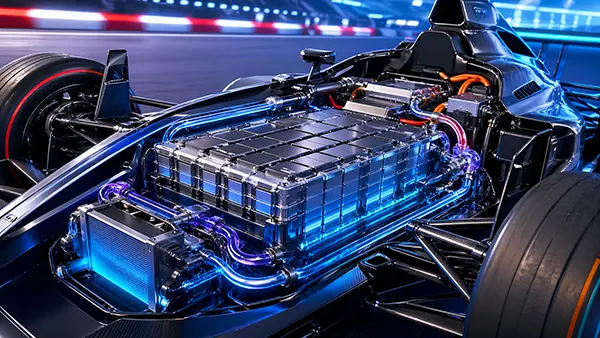
Liquid cooling remains the primary method, with coolant flowing through channels surrounding the battery cells. This approach provides consistent heat removal and helps maintain uniform temperatures across the entire pack. Uneven temperature distribution can lead to local hotspots, which accelerate degradation and reduce overall efficiency.
In addition to liquid systems, engineers are exploring phase-change materials and advanced heat exchangers that absorb and redistribute heat more effectively. These solutions allow the battery to handle short bursts of high load without immediate temperature spikes, improving both performance and durability.
The role of software and data in thermal control
Modern thermal management depends heavily on software. Real-time data from sensors is processed by onboard systems that continuously adjust cooling parameters. This includes regulating coolant flow, activating auxiliary cooling components, and balancing temperature across different sections of the battery.
Teams also use predictive modelling to anticipate thermal behaviour before issues arise. By analysing previous race data, track layouts, and environmental conditions, engineers can forecast when and where the battery is likely to overheat. This allows them to plan energy usage and cooling strategies in advance.
Simulation tools play a key role in development. Engineers can recreate race scenarios and test how different cooling configurations perform under varying conditions. This level of preparation ensures that systems are optimised not only for peak performance but also for reliability across the entire race distance.
Safety, reliability, and the long-term impact on electric racing
Battery cooling is essential for safety. If temperatures rise uncontrollably, there is a risk of thermal runaway, where battery cells generate heat faster than it can be dissipated. This can lead to severe damage or, in extreme cases, fire. Formula E regulations require strict monitoring and fail-safe systems to minimise such risks.
Reliability is closely tied to thermal management. Batteries exposed to excessive heat degrade more quickly, losing capacity and efficiency over time. In a championship that spans multiple races, maintaining consistent battery performance is critical for achieving strong results across the season.
The technologies developed in Formula E have implications beyond motorsport. Lessons learned from high-performance electric racing are applied to road vehicles, where efficient cooling improves battery lifespan, charging performance, and everyday usability.
What this means for the future of Formula E
Looking ahead, battery cooling will become even more important as Formula E continues to evolve. Future cars are expected to deliver higher power outputs and faster energy recovery, both of which increase thermal stress on battery systems. This will require even more advanced cooling solutions.
There is also a growing focus on efficiency. Engineers aim to reduce the energy required for cooling while maintaining effectiveness, ensuring that more energy is available for propulsion. This balance is crucial for both performance and sustainability goals within the championship.
Battery cooling is no longer just a technical detail—it is a defining factor in modern electric racing. Teams that master thermal management will not only improve performance but also set the direction for future developments in both motorsport and the wider electric vehicle industry.