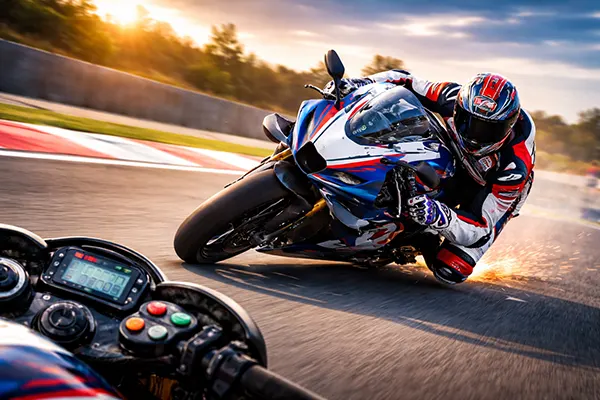
MotoGP Electronics Guide: Traction Control, Engine Brake & Rider Maps (2025)
MotoGP bikes look wild because they are: around 300 bhp, ultra-light, and ridden at lean angles where normal road physics stops making sense. What keeps them rideable isn’t only talent — it’s the electronics working in the background. The good news is that modern MotoGP has a unified ECU and software environment, so the core ideas are similar across teams. This guide breaks down traction control, engine braking control, and the “maps” riders use, in plain terms, with the 2025 context in mind.
The Electronic “Brain”: ECU, Sensors and What the Rider Actually Controls
Every MotoGP bike is managed by a spec (unified) ECU supplied by Marelli, with common software rules designed to keep costs under control and prevent an electronics arms race. Teams still tune and configure a lot, but they do it within a shared framework — that’s why you often hear commentators talk about “settings” and “maps” rather than secret custom computers. In 2023, a newer ECU generation (BAZ-340) was introduced to handle higher processing and data demands, and that hardware is part of the modern baseline fans see today.
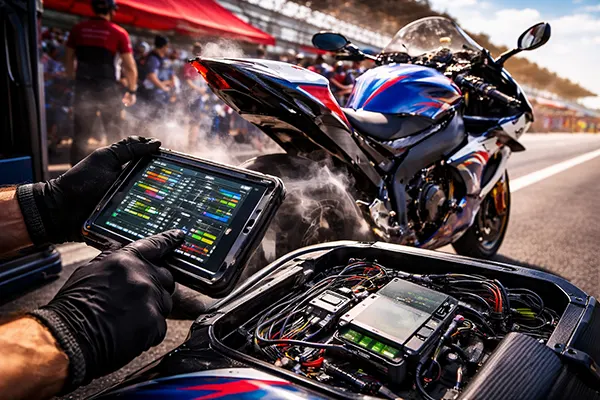
Under the fairing, the ECU is fed by a dense network of sensors: wheel speed sensors front and rear, throttle position, IMU (measuring lean, pitch and yaw), brake pressure, gear position, engine speed, and more. The ECU reads this in real time and applies control strategies for torque delivery, wheel slip, engine braking, anti-wheelie, and launch behaviour. The rider interacts with this mostly through handlebar switches, plus what they feel through the bike when the system intervenes.
It’s important to separate “automatic magic” from what’s really happening. MotoGP electronics are not an autopilot. The systems react to slip, lean, acceleration and engine conditions — but riders still choose when to switch maps, how hard to push into a corner, and how much to trust the intervention. In practice, electronics help turn a knife-edge machine into something that can be ridden on the limit for 20+ laps without the tyres falling off a cliff immediately.
What “Maps” Mean in MotoGP — and Why Riders Change Them Mid-Race
When commentators say “he’s gone to Map 2”, they’re usually talking about a pre-set package of parameters. A map can alter torque delivery, engine braking strength, traction control aggressiveness, fuel strategy, and sometimes the behaviour of corner-entry or corner-exit systems. Think of it like switching the bike’s personality: smoother drive to protect the rear tyre, sharper response to attack, or a safer setting for tricky grip conditions.
These maps are not one-size-fits-all. Riders often have several options tailored to track temperature, tyre wear, fuel consumption, and even how confident they feel in the front end. A common pattern is starting with an aggressive setting when tyres are fresh, then switching to a gentler map when the rear starts spinning more as grip drops. This is also why you’ll see riders change settings behind another bike — dirty air and different lines can alter traction demands corner by corner.
In 2025, teams also have to work around the fact that everyone runs within the same ECU ecosystem. That tends to shift the advantage from “who has the cleverest computer” to “who understands the tyre behaviour and can build the best set of maps for each phase of the race”. Riders with a strong feel for grip often look like they have “better electronics”, when really they’re choosing the right tools at the right time.
Traction Control: How It Prevents Highsides Without Killing Speed
Traction control (TC) in MotoGP is mainly about managing rear wheel slip — not eliminating it. A small, controlled amount of slip is often faster because it helps rotate the bike and keep the engine in the power. The ECU watches the difference between front and rear wheel speeds, then cross-checks it with lean angle and acceleration data from the IMU. If the rear spins too quickly for the conditions, the ECU reduces torque to keep the slide within a workable range.
The key detail is how torque is reduced. MotoGP can cut torque through ignition timing changes, fuel delivery adjustments, and throttle control (the bikes use ride-by-wire). The smoother the intervention, the more it helps the rider. A harsh cut can unsettle the chassis, especially at high lean, and that can be as dangerous as too much spin. That’s why TC isn’t simply “more is safer”: too much intervention can make the bike unpredictable and cost lap time.
TC also ties into tyre management. As the rear tyre wears, the threshold where a slide becomes risky changes. Riders will often increase TC support later in the race or choose a map with softer torque delivery. In mixed conditions, riders may favour stability over outright drive. That’s one reason MotoGP looks so different on a cold Friday morning versus a hot Sunday race.
Traction Control vs Anti-Wheelie and the New 2025 Focus on Stability
Fans often mix up traction control and anti-wheelie because both reduce power when the bike tries to do something dramatic. Anti-wheelie focuses on front wheel lift: if the bike pitches up too much, the ECU trims torque to bring the front down. Traction control focuses on rear slip: it aims to prevent sudden spikes in wheelspin that can lead to a violent grip snap-back and a highside.
A major 2025 talking point is the arrival of a stability control concept (sometimes described as slide or stability control) introduced through ECU updates at the Austrian GP. The goal is to reduce the risk of highsides further by managing the transition between controlled slide and sudden grip recovery. This doesn’t remove rider skill — it aims to make the dangerous edge slightly less brutal, especially when tyres degrade or when riders hit unexpected grip changes mid-corner.
That change matters because modern MotoGP bikes generate huge acceleration even while leaned over. The line between “fast slide” and “instant crash” is thin. Systems that smooth that transition can reduce the number of violent incidents without turning the sport into a computer game. Riders and teams still debate how much intervention is “too easy”, but the safety motivation is clear.
Engine Brake Control: Why Corner Entry Is an Electronics Battle
When a rider closes the throttle and downshifts from 340 km/h into a corner, the engine itself becomes a braking force. That “engine braking” can help slow the bike, but it can also destabilise the rear wheel, especially when the tyre is lightly loaded and the bike is still leaning. If the rear locks or chatters, the rider loses line control — and the front tyre can become overloaded as they fight the bike.
Engine brake control lets teams tune how strong that deceleration effect is, and how it changes across gears and lean angles. The ECU can open the throttle butterflies slightly, manage ignition timing, and work with the seamless gearbox behaviour to keep the rear wheel rotating smoothly. The aim is not to remove engine braking, but to make it predictable: strong enough to help stop the bike, gentle enough to avoid rear instability.
This is also why two riders on the same team can prefer different engine brake settings. One rider might want the rear to “help steer” on entry by allowing a small amount of slip. Another might want a calmer rear to protect the front tyre and avoid sudden snaps. Track layout matters too: stop-and-go circuits often need different engine brake behaviour compared to fast flowing tracks where stability is everything.
Engine Brake Maps: What Riders Feel and What Engineers Tune
Riders describe engine brake settings in terms of feeling: “the bike turns in better”, “the rear pushes”, “it wants to stop too much”, or “it runs on”. Under the hood, engineers are adjusting deceleration torque targets, throttle blip behaviour, and the way the ECU blends engine braking with rear grip. It’s subtle, but at MotoGP speed subtle is everything — a small change can decide whether the rider can trail brake deep into the apex or has to release early.
Engine brake maps are often adjusted during a weekend as rubber goes down and grip improves. In early sessions, teams may run safer settings to avoid rear instability when the track is green. As grip rises, they can use stronger engine braking to shorten braking distances and help rotate the bike. Weather swings can force a return to calmer settings because cold tyres and strong engine braking can be a nasty combination.
One of the most overlooked parts is how engine brake control interacts with the front tyre. If the rear is too loose on entry, the rider may compensate by loading the front more aggressively, increasing the chance of a front-end loss. If the rear is too stable, the bike may understeer and refuse to rotate. The best settings are not “maximum braking” — they’re the ones that let the rider hit the same entry speed lap after lap.