Night Races: How Lighting, Temperature and Visibility Affect Results
Night racing is not simply daytime motorsport moved to a later hour. Artificial lighting changes how drivers recognise braking points and judge distances, while falling track temperatures can alter tyre behaviour from one session to another. Visibility can also change quickly when traffic, rain, spray or reflections enter the picture. Formula 1 provides some of the clearest examples: Singapore has been racing under floodlights since 2008, while events such as Las Vegas demonstrate how dramatically a circuit can cool after sunset. The result is a form of racing in which preparation must account for the local climate as much as the fact that the circuit is illuminated. A driver who feels confident during qualifying may face noticeably different grip during the race, while a team that correctly anticipates temperature changes can gain positions without necessarily having the fastest car over a single lap.
How Artificial Lighting Changes the Way Drivers Read a Circuit
The first requirement for a successful night race is not simply a large quantity of light. Drivers need consistent illumination that allows them to recognise the road surface, kerbs, barriers, braking markers and other cars while travelling at racing speed. Modern floodlit circuits are designed to provide a level of visibility that can feel surprisingly close to daylight from inside the cockpit. Singapore is a useful example. Despite the city being completely dark beyond the illuminated circuit, drivers have repeatedly described the track itself as exceptionally well lit. That matters because a racing driver does not have time to consciously identify every object ahead. Much of the process depends on familiar visual references that are recognised almost automatically after repeated practice laps.
Artificial light can nevertheless change the appearance of familiar objects. A painted kerb may look brighter than it does during the afternoon, while the edge of a barrier can appear sharper against a dark background. Shadows also behave differently because floodlights illuminate the road from fixed positions rather than following the changing angle of the sun. The effect is particularly noticeable on street circuits, where walls, fencing, advertising boards and buildings create a much busier visual environment than an open permanent circuit. Drivers therefore spend practice sessions learning not only the racing line but also how their usual reference points appear under the lighting that will be used during qualifying and the race.
The consistency of that lighting is more important than spectacular brightness. If one section appears significantly darker than the section immediately before it, a driver’s eyes have to adjust while the car is still moving at high speed. Modern night-race installations are intended to minimise such transitions, especially around braking zones and corners where precise judgement is essential. This is one reason night sessions held under properly designed floodlights do not automatically produce poor visibility. At Singapore, for example, the challenge has traditionally come more from the narrow street layout, heat and physical workload than from an inability to see the circuit. A well-lit track allows drivers to attack with confidence, but it cannot remove every visibility problem created by weather or traffic.
Why Brightness and Useful Visibility Are Not the Same Thing
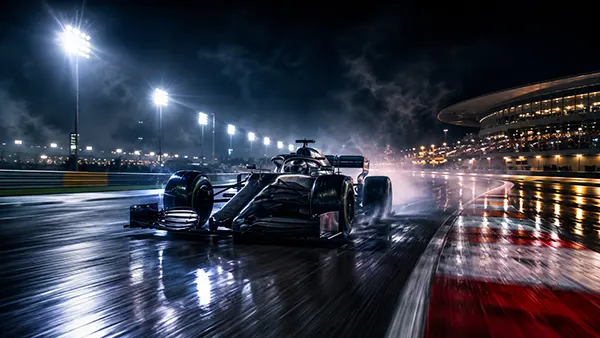
Useful visibility depends on contrast as well as brightness. A driver needs to distinguish the road from a kerb, another car from the background and a braking marker from the objects surrounding it. Excessive glare can therefore be as distracting as insufficient light. Reflections from polished surfaces, wet asphalt or painted sections of the circuit can make parts of the road appear much brighter than their surroundings. On a dry night the lighting may be extremely predictable, but rain changes the picture because water creates additional reflections and can reduce the visual contrast between different parts of the track. The same circuit can consequently feel very different within a few minutes.
Spray adds another difficulty during wet races. Water thrown into the air by tyres can scatter artificial light and obscure the car ahead, particularly when several cars are travelling closely together. Drivers then rely heavily on the visible outline and warning lights of other cars rather than on a completely clear view of the road. This is not a problem limited to night racing, but artificial lighting changes the way spray, reflections and illuminated signals appear. The FIA continued to work on visibility-related safety measures for the 2026 Formula 1 rules, including changes intended to provide clearer and more consistent rear-light signals to drivers following another car in poor conditions.
These details can influence a result because confidence affects how late a driver is willing to brake and how closely they can follow another car. Losing only a small amount of certainty at a corner can make the difference between attempting an overtake and staying behind for another lap. The effect becomes larger when visibility changes suddenly after rain begins or when a driver moves from clean air into a group of cars. Night races therefore reward drivers who adapt their visual references quickly. The fastest approach is not always to attack every corner immediately; sometimes the more effective choice is to spend a lap establishing where grip, reflections and visibility have changed before returning to maximum pace.
Why Temperature After Sunset Can Change Tyres and Strategy
Temperature is one of the most important reasons two night races can behave completely differently. Asphalt absorbs heat during daylight and releases it after sunset, but the rate of cooling depends on the location, weather, surface and starting time. A falling track temperature can make it harder for tyres to reach the operating condition in which they provide predictable grip. This is particularly important after a pit stop, during an out-lap in qualifying or following a slow period behind the Safety Car. A driver may leave the pits on fresh tyres but still need time before those tyres provide the grip required for aggressive braking and acceleration.
Las Vegas demonstrates the effect clearly. The city lies in the Mojave Desert, where the difference between daytime and late-night temperatures can be substantial. Its Formula 1 event takes place very late in the day, so teams have had to pay close attention to cool asphalt and tyre warm-up. A tyre that takes longer to reach an effective temperature can leave a driver vulnerable immediately after a pit stop. It can also complicate qualifying because a driver must prepare the tyres correctly before beginning the timed lap. Pushing too hard during preparation may be counterproductive, while beginning the lap with tyres that are still too cool can reduce confidence and grip through the opening corners.
Singapore presents almost the opposite problem. Although the race takes place at night, its equatorial climate means the temperature does not fall in the way many spectators might expect. Heat and humidity remain high, and tyre supplier Pirelli identified thermal stress as a major source of tyre performance loss at the 2025 Singapore Grand Prix. This makes Singapore a useful reminder that the words “night race” do not describe one fixed set of conditions. Darkness may be common to all such events, but local climate determines whether teams are trying to generate enough tyre temperature or prevent excessive heat from damaging performance over a long stint.
Why the Same Night-Race Approach Does Not Work at Every Circuit
A setup that works well in Las Vegas cannot simply be transferred to Singapore because the tyres face different problems. In cooler conditions, maintaining tyre temperature and grip may be the priority. In hot conditions, controlling overheating and avoiding unnecessary sliding can become more important. Sliding generates additional heat while also wearing the tyre surface, so an aggressive driving style can sometimes make a difficult situation worse. Drivers may therefore change the way they accelerate from slow corners or manage the opening laps of a stint depending on how quickly the tyres are responding.
The timing of practice sessions is especially useful at night events. Teams want to collect data in conditions that resemble qualifying and the race because information recorded during a much hotter daytime session may not provide an accurate picture of later tyre behaviour. Engineers compare lap times, tyre condition and driver comments to understand how quickly grip develops as the circuit cools. Drivers contribute information that cannot always be understood from numbers alone: whether the front tyres respond immediately to steering input, whether the rear of the car feels secure under acceleration and whether the level of grip is changing from lap to lap.
Temperature can also change the value of a particular race strategy. An early pit stop may look attractive if new tyres provide an immediate pace advantage, but the benefit is smaller when fresh tyres need several corners or even laps to reach their most useful condition. Conversely, keeping an older set of tyres for too long can become expensive at a hot circuit if performance begins to deteriorate rapidly. Teams therefore have to consider more than the theoretical life of a tyre. They need to estimate the condition of the track at the moment each stop is likely to take place, the traffic a driver will encounter afterwards and how easily the replacement tyres can be brought into an effective working state.
How Visibility, Traffic and Driver Fatigue Affect the Final Result
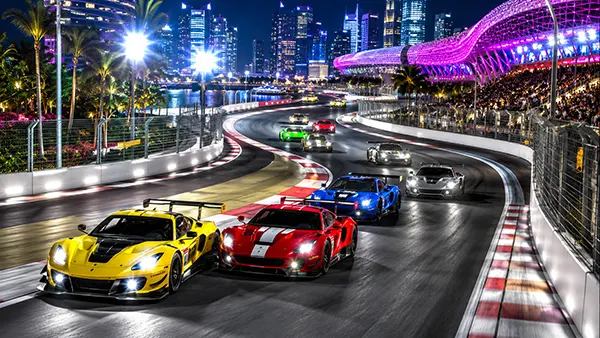
Visibility during a night race is influenced by much more than the lamps above the circuit. A driver may have a clear view when running alone but a very different experience when following another car closely. The car ahead can obscure braking markers, kerbs and the exact position of the corner entry. On a street circuit this can become particularly demanding because barriers leave little room to correct a mistake. Singapore and Las Vegas both contain sections surrounded by walls, although their layouts and speeds are very different. In both cases, a driver must judge the circuit while simultaneously monitoring rivals, warning signals and changing grip.
Artificial lighting can also make the surroundings appear more visually complex. Bright buildings, illuminated signs and other sources of light may exist beyond the circuit even though the racing surface itself is carefully illuminated. Experienced drivers learn to separate useful information from background detail. What matters is the sequence of reliable references: a distance board, the start of a kerb, a change in barrier position or another feature that identifies when to brake and turn. A mistake of only a few metres can compromise the entire corner. On narrow tracks it may also lead to contact with a wall, meaning visual consistency becomes part of risk management as well as outright speed.
Physical condition is another factor. Racing after dark does not guarantee comfortable temperatures. Singapore remains one of the most physically demanding events because high humidity and heat continue deep into the evening. Drivers prepare specifically for the thermal load, while teams traditionally maintain working schedules that keep personnel closer to European time rather than completely adapting to local daylight hours. This unusual routine helps align sleep and alertness with late track sessions, but it also demonstrates how much preparation takes place away from the car. Concentration can become especially important late in a long race, when fatigue combines with repeated braking, steering inputs, heat and constant proximity to walls.
How Drivers and Teams Turn Night Conditions into Race Performance
The most effective preparation begins before race day. Practice gives drivers an opportunity to confirm which visual references remain reliable under artificial lighting and to understand how the tyres respond as the evening develops. Teams can then adjust their plans rather than assuming that conditions will remain constant. A driver who reports poor front-end grip early in a session may find the balance changes as the track cools. Another may struggle with tyre warm-up only when leaving the pits. Treating these comments as part of the overall race picture helps teams avoid making decisions based on a single lap or a single temperature reading.
Race interruptions can make the situation more complicated. During a Safety Car period, speeds fall and tyres lose temperature. When racing resumes, the driver who restores grip most effectively can attack immediately, while another may need to defend until the car feels predictable again. Visibility can also become more difficult during a restart because the field is closely packed. Warning lights, trackside signals and clear communication from the team become particularly important in these moments. Changes introduced to Formula 1’s rear-light arrangements for 2026 reflect the continuing emphasis on making the behaviour and status of cars easier for following drivers to interpret when conditions are difficult.
Night racing ultimately rewards adaptability rather than one specialised technique. Singapore shows that darkness can coexist with intense heat, high humidity and significant tyre stress. Las Vegas shows that a floodlit race can instead be shaped by a substantial fall in temperature and the challenge of generating grip on cooler asphalt. Rain can turn excellent dry-weather visibility into a much more complicated mixture of spray, glare and reflections, while traffic can hide visual references even when the lighting itself is ideal. The strongest results usually come when drivers and teams recognise these changes early and adjust pace, tyre preparation and strategy accordingly. Artificial lights create the appearance of consistency, but the conditions beneath them continue to change throughout the night.