IndyCar IR-28: What the New Car Will Be Like After More Than a Decade of DW12 Evolution
IndyCar is preparing for one of the biggest technical changes in its modern history. The new Dallara IR-28 is scheduled to make its competitive debut in 2028, finally replacing the basic chassis architecture that has underpinned the series since 2012. That long service life does not mean the present car has remained unchanged: the DW12, also known in its original specification as the IR-12, has received new bodywork, major safety additions and hybrid technology during its career. By 2026, however, those successive updates have created a car carrying far more equipment and weight than its original designers had to accommodate. The IR-28 is intended to reset that process. Rather than adding another layer to the existing design, Dallara and INDYCAR have started again with a car conceived around modern safety requirements, hybrid power and the need for closer racing. The result is expected to be lighter, faster and easier to follow in traffic while still looking and behaving like an Indy car rather than an entirely different type of racing machine.
Why IndyCar Is Finally Replacing the Long-Serving DW12
The current generation began racing in 2012, giving the underlying Dallara design an unusually long life by top-level single-seater standards. Longevity has brought important advantages. Teams have gained an exceptionally deep understanding of the car, replacement parts have been standardised and the common chassis has helped prevent the kind of development spending that can create enormous gaps between competitors. It has also produced some extremely close racing across a championship that asks one basic car to compete on street circuits, permanent road courses, short ovals and high-speed superspeedways. Instead of replacing the chassis every few years, IndyCar repeatedly developed it around changing needs. That approach gave the series stability, but it also meant that a car designed in the early 2010s eventually had to accommodate technologies and safety requirements that had not formed part of the original package.
The most visible transformation arrived for 2018, when the manufacturer-specific aerodynamic kits previously used by Chevrolet and Honda were replaced by universal bodywork. The underlying Dallara chassis remained, but the car received the cleaner and more traditional open-wheel appearance that has defined modern IndyCar racing. Another substantial change followed in 2020 with the introduction of the aeroscreen, combining a ballistic windscreen and structural frame around the cockpit to improve protection from debris and frontal impacts. A lighter version subsequently arrived in 2024. Later that season, IndyCar introduced its first competition hybrid system, adding a motor-generator and energy storage equipment to the existing 2.2-litre twin-turbo V6 engine package. Each development served a clear purpose, but each also had to be incorporated into a chassis whose basic architecture dated back more than a decade.
Weight became an increasingly important reason to consider a replacement. The existing car grew heavier as safety equipment, the aeroscreen and hybrid components were added, while some of that extra mass accumulated towards the rear. INDYCAR engineers have explained that this can influence balance and make the car less settled in certain situations, particularly when braking or running at Indianapolis. A clean-sheet design makes it possible to position equipment more logically instead of adapting available space in an older structure. The IR-28 is therefore not simply a new body fitted to the DW12. It is a newly designed chassis intended to incorporate the lessons of the previous generation from the beginning. INDYCAR plans for it to start racing in 2028, giving the DW12 family a competitive lifespan of roughly 16 seasons before the change takes place.
What IR-28 Keeps and What It Changes
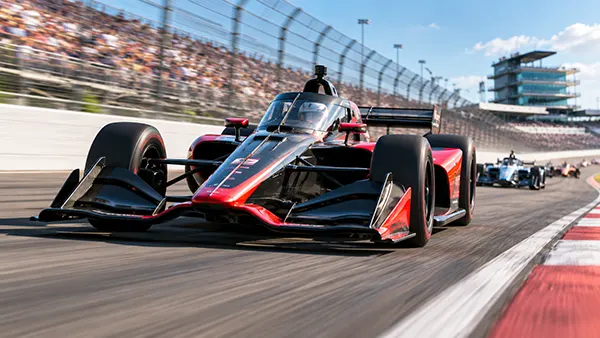
Although almost everything underneath is being reconsidered, INDYCAR has deliberately avoided making the IR-28 visually unrelated to the cars that came before it. The proportions remain recognisably those of an American open-wheel racing car, with exposed wheels, compact bodywork and different aerodynamic configurations for road courses and superspeedways. The front and rear wings have been redesigned, the engine cover is lower and cleaner, and the aeroscreen fits more naturally into the overall shape because it was considered during the original design process instead of being added years later. That distinction matters. On the current car, later safety and performance changes had to work around an existing structure. On the IR-28, those features can influence the dimensions, airflow and packaging of the car from the first stage of development.
One of the clearest targets is a reduction of approximately 100 lb compared with the present car. In racing terms, that is a substantial change, particularly because IndyCar does not want to achieve it by sacrificing safety. The new hybrid equipment is expected to be around 20 lb lighter than the system it replaces, while the new Xtrac gearbox is being developed to save another 25 lb. The cockpit itself will be wider inside, giving more room to drivers with different body shapes and heights. Cooling and airflow around the driver are also being improved. These changes address complaints that accumulated during the life of the DW12, when additional equipment gradually reduced available space and made heat management more difficult, especially during hot street and road-course events.
The design also considers details that matter to spectators and teams without changing the fundamental character of the racing. A digital position display will show where a car stands during practice, qualifying and races, while lights on the rear-wing endplates can communicate useful information about conditions or a car experiencing a problem. A transparent section in the engine cover is intended to make manufacturer branding more visible, and the bodywork provides additional usable space for team sponsors. These are relatively small features beside a new chassis or engine, but they illustrate how much easier it is to design them into a new car than to keep modifying an older one. The IR-28 has also been laid out with room for future developments, reducing the likelihood that the series will immediately encounter the same packaging limitations that gradually affected its predecessor.
How the IR-28 Is Being Shaped for Faster, Closer Racing
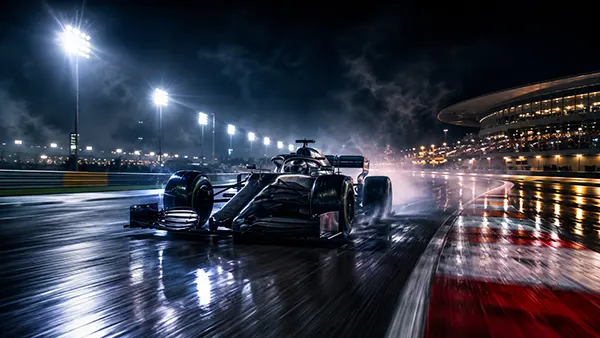
IndyCar has made improved racing in traffic one of the central aims of the IR-28 programme. A racing car inevitably disturbs the air as it travels, and the driver behind has to deal with that wake. The problem becomes particularly obvious in fast corners, where a following car can lose aerodynamic grip just when the driver needs it most. The IR-28 has therefore been designed with greater attention to what happens to the air after it leaves the car, rather than concentrating only on producing downforce for the car running by itself. New front and rear wings, revised floor areas and bodywork around the front wheels are intended to create a cleaner wake. If the concept works as planned, a driver following another car should lose less performance and have a better opportunity to remain close enough to attempt a pass.
This approach is important because IndyCar cannot optimise its main car for only one type of circuit. A Formula One car spends its life on road courses, while an Indy car must also operate on short ovals and at Indianapolis Motor Speedway at speeds well above 200 mph. The IR-28 therefore has separate aerodynamic configurations designed around very different jobs. On road and street courses, the wings can create the grip needed for braking and cornering. In superspeedway specification, the priority shifts towards stability and efficiency with much lower resistance through the air. For Indianapolis, engineers have also worked on making the front wing more stable when a driver is running behind other cars. That could prove particularly significant during the Indianapolis 500, where confidence in traffic often determines whether a quick car can actually move through the field.
Less weight should strengthen the effect of those aerodynamic changes. Removing around 100 lb while increasing engine performance gives the IR-28 a better power-to-weight ratio, meaning the car does not need an enormous increase in horsepower to become quicker. INDYCAR has openly stated that the new car is intended to beat current lap times and potentially challenge long-standing records. Indianapolis provides the most obvious reference: Arie Luyendyk’s official one-lap and four-lap qualifying records have stood since 1996. A record attempt is not guaranteed simply because a new car exists, and track conditions, boost levels, tyres and regulations will all matter in 2028. Still, the fact that record-breaking performance is an explicit design objective shows that IndyCar is not treating the IR-28 simply as a safety-led replacement for an ageing chassis.
New Hybrid Power Without Making the Car Needlessly Complicated
The IR-28 will arrive with a new generation of combustion engines as well as a redesigned hybrid system. Chevrolet and Honda have both committed to the 2028 rules, with 2.4-litre twin-turbocharged V6 engines replacing the 2.2-litre units used by the current cars. INDYCAR says the new engines will be capable of producing up to 760 horsepower from the combustion side of the package at the outset, together with increased torque. That is an important change because the series had originally considered larger engines years earlier before postponing the plan. The 2028 programme finally brings that capacity increase together with a chassis designed specifically to accept it, rather than asking teams to fit another major update around the architecture introduced in 2012.
The electrical side will also change significantly. IndyCar’s present hybrid system, introduced during the 2024 season, stores recovered energy in supercapacitors. The IR-28 will switch to a battery-based energy storage system supplied by BOLD Technology, paired with new electrical hardware from Helix. For viewers, the most important point is not the terminology but what the change is intended to provide. INDYCAR says the new battery will offer roughly 14 times the energy storage capacity of the current system. That gives drivers and engineers more freedom over when stored energy is used during a lap or race. Rather than hybrid power serving as only a short additional burst, the larger reserve creates scope for more varied deployment while still keeping the driver involved in how that energy contributes to performance.
The hybrid package is also expected to be approximately 20 lb lighter than the current unit, which helps explain how IndyCar can add capability while reducing the overall mass of the car. The transmission contributes to the same goal, with the new gearbox planned to save roughly 25 lb. Taken together, the engine, hybrid and transmission changes should make the car feel more responsive without turning the series into a competition centred entirely on energy-management software. IndyCar still wants braking, car control, tyre use, traffic management and driver judgement to remain visible parts of racing. Chevrolet and Honda will continue to compete as engine manufacturers, while teams will still work with a common chassis. That balance preserves the championship’s familiar structure while giving manufacturers a new generation of powertrain technology to develop.
Safety and Driver Control Are Central to the New Car
Higher speed makes the safety programme especially important. The IR-28 has been designed around current knowledge rather than relying on additions to a structure conceived before several modern IndyCar safety measures existed. INDYCAR says the new chassis is being developed to meet whichever requirement is more demanding between its own standards and relevant FIA specifications. The aeroscreen remains an essential part of the car, but its next version will be lighter and more closely integrated with the chassis. The roll structure, cockpit and side-impact areas have also been considered as parts of a single design. That is a major difference from the development path of the DW12, where several advances were introduced after the original chassis had already entered competition.
The cockpit will provide more internal space and is intended to accommodate a wider range of driver sizes. That may sound like a comfort issue, but it also has a safety purpose: giving the driver’s body, arms and equipment sufficient room can reduce unwanted contact with hard surfaces during an accident. Ventilation is being improved as well, which should help drivers cope with events held in extreme heat. The side structures are designed to absorb more energy in heavy impacts, while the overall shape has been developed to improve the car’s tendency to remain on the ground when it is sliding, spinning or beginning to lift nose-first. Preventing a car from becoming airborne is particularly important on ovals, where an accident can begin at very high speed and develop rapidly once the car changes direction.
Drivers will also gain easier control over some adjustments that currently require physical levers or mechanisms around the cockpit. The IR-28 will use electronically controlled anti-roll bar adjustment, allowing the driver to alter the car’s balance without removing a hand from the steering wheel. In simple terms, that gives a driver another way to respond when tyres, fuel load or track conditions change during a stint. A new suspension arrangement is also intended to help teams find mechanical grip rather than relying too heavily on aerodynamic load. That could be particularly useful when a car is following another one and the airflow is less favourable. The objective is not to make the driver responsible for dozens of extra settings, but to provide useful adjustment while removing some of the bulky controls that have occupied space beside the driver in the current chassis.
What the 2026 Tests Already Say About the IR-28
The first real indication of how the car behaves arrived at Indianapolis Motor Speedway on 1 August 2026. Alexander Rossi completed the opening on-track validation session on the 2.439-mile road course, beginning the process of checking whether the physical car behaved as simulations and development work predicted. Damp conditions limited some running, but the prototype completed its programme without a major reliability problem. Rossi reported that the baseline was comfortable from the beginning, an encouraging sign for a car carrying a new chassis, new aerodynamics, new electronics and different suspension components. That session was never intended to establish final lap-time potential. Its main value was confirming that the fundamental package worked before engineers began making more detailed changes and taking the car into faster, more specialised environments.
A more revealing milestone came on 9 and 10 September, when the IR-28 completed its first oval validation test on the 2.5-mile Indianapolis Motor Speedway. Rossi drove on the opening day before Alex Palou took over on the second, giving INDYCAR feedback from two Indianapolis 500 winners and from representatives of both Chevrolet- and Honda-powered teams. Across the two days, the car completed 151 laps. RACER recorded an unofficial peak of 217.9 mph, but that figure should not be treated as a preview of the car’s ultimate Indianapolis speed. The prototype was being run conservatively, without the final 2028 hybrid package and with a development version of the 2.4-litre engine operating below its eventual potential. Engineers were deliberately changing settings and ride heights to compare real behaviour with wind-tunnel and computer predictions rather than chasing a qualifying-style lap.
The most useful result from the September test was therefore predictability rather than outright speed. Rossi said the car behaved as an Indy car should at Indianapolis and did not reveal a major unexpected problem, while Palou completed the second-day programme early after the planned checks had been finished. Engineers also reported that many of the changes made to the prototype produced the effects predicted during earlier development work. There are still almost two years between these tests and the IR-28’s first championship race, so its final aerodynamic details, set-up preferences and true performance in a pack cannot yet be judged. What can be said in 2026 is that the project has moved beyond drawings and theory. The new chassis has run successfully on both the Indianapolis road course and oval, its main structures are approaching production readiness, and the direction is clear: IndyCar wants its 2028 car to retain the close competition of the DW12 era while shedding the compromises accumulated during 16 years of continuous evolution.